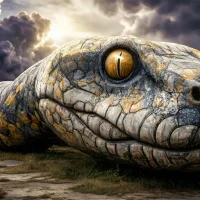
Scientists identified a newly discovered ancient snake species, Vasuki indicus, from fossilized vertebrae found in Gujarat, India, that lived approximately 47 million years ago and measured 11 to 15 meters long, potentially rivaling Titanoboa as one of the largest snakes ever to exist. The thick-bodied reptile likely relied on slow ambush predation similar to modern anacondas and belonged to the extinct madtsoiidae family, which researchers suggest may have originated on the Indian subcontinent before dispersing to Europe and Africa.
 Topicle Beta




1 comment
Scientists identified a newly discovered ancient snake species, Vasuki indicus, from fossilized vertebrae found in Gujarat, India, that lived approximately 47 million years ago and measured 11 to 15 meters long, potentially rivaling Titanoboa as one of the largest snakes ever to exist. The thick-bodied reptile likely relied on slow ambush predation similar to modern anacondas and belonged to the extinct madtsoiidae family, which researchers suggest may have originated on the Indian subcontinent before dispersing to Europe and Africa.