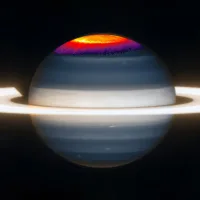
Astronomers using the James Webb Space Telescope solved a decades-old mystery about Saturn's changing rotation rate, discovering that powerful atmospheric winds driven by the planet's aurora create electrical currents that sustain a self-reinforcing heating cycle rather than the planet actually spinning faster or slower. The findings, published in the Journal of Geophysical Research: Space Physics, reveal that Saturn's aurora heats the atmosphere, which generates winds that produce currents powering the aurora in a continuous planetary heat pump.
 Topicle Beta





1 comment
Astronomers using the James Webb Space Telescope solved a decades-old mystery about Saturn's changing rotation rate, discovering that powerful atmospheric winds driven by the planet's aurora create electrical currents that sustain a self-reinforcing heating cycle rather than the planet actually spinning faster or slower. The findings, published in the Journal of Geophysical Research: Space Physics, reveal that Saturn's aurora heats the atmosphere, which generates winds that produce currents powering the aurora in a continuous planetary heat pump.